Architectural Walk: Addresses of the Jūrmala Historical Architecture Award Finalists

Photo: Gundars Ūķis, Jūrmala Centre for Cultural Space and Environmental Design
Jūrmala’s distinctive character is shaped to a great extent by its architecture – large and small summer houses, villas, and historic seaside buildings that reflect the city’s development across different periods. To draw attention to the preservation of this heritage and to highlight the finest examples of restoration, renewal, and reconstruction, the Jūrmala Historical Architecture Award was established five years ago. The award recognises buildings whose renewal has carefully preserved their historic character – from façade details to the building’s overall atmosphere and harmony with its surroundings.
This walking route leads past the award finalists’ buildings, each with its own story and architectural character. Along the way, one encounters a 19th-century fisherman’s homestead by the sea with a reed roof, an Art Nouveau guesthouse with a veranda and tower, and an interwar villa designed by architect Eižens Laube. From a romantic wooden summer house nestled among pines to an elegant jewel of resort architecture, each stop reveals a different period in Jūrmala’s architectural history and its presence in the contemporary urban landscape.
This selection includes the finalists of the 2024 and 2025 Jūrmala Historical Architecture Award, arranged geographically from Lielupe to Kaugurciems. They are highlighted examples from a wider network of city walking routes, including the City Routes and the Jūrmala Wooden Architecture Route, which pass through different neighbourhoods and reveal the diversity of the seaside built heritage.


19. līnija 1, Lielupe (Jūrmala Historical Architecture Award 2025 – 3rd place, national architectural monument)
This elegant villa, built in 1928 to a design by the distinguished architect Eižens Laube, is an expressive example of interwar resort architecture in Jūrmala. The house was originally designed as a summer residence for entrepreneur, educator, and public figure Jānis Dāvis (1867–1959) – a man who wrote school textbooks, supported the construction of schools, and generously bequeathed property to the University of Latvia. The plastered two-storey wooden building is conceived in a classical idiom: symmetry, columns, and an arched loggia lend it a restrained, aristocratic character, and at first glance it is difficult even to guess that behind the elegant façade lies a timber structure. During the restoration, a contemporary extension was added, yet it was designed so discreetly that the focus remains firmly on Laube’s historic villa.


Rēzeknes pulka iela 20, k-1, Bulduri (Jūrmala Historical Architecture Award 2025 – finalist, culturally significant building to be preserved)
This rental house was built in 1926 by a Baltic German named Villibald, who later used its income to build three more houses on his plot, convinced of the area’s development potential. Its asymmetrical volume, towers, richly detailed timber ornament, and National Romantic features are characteristic of Jūrmala’s interwar guesthouse architecture. During the restoration, the façade cladding was renewed, decorative elements and tower spires were restored, and a new extension with matching timber cladding was designed to merge organically with the historic building. Nearly a century later, the house still fulfils its original function, welcoming guests and residents, albeit now in modernly adapted apartments.


Bulduru prospekts 79, Bulduri (Jūrmala Historical Architecture Award 2024 – 1st place, local cultural monument)
This summer house, more than a century old and built in 1909 to a design by Baltic German architect and art historian Heinz Pirang (1876–1936), is a striking example of National Romanticism in Jūrmala’s wooden architecture. Its volume, with sloping gables, a veranda, balcony, and second-floor loggia, creates a picturesque silhouette, while the restrained refinement of its details lends the building an elegant character. The façade is adorned with carved wooden ornament on the veranda and loggia, revealing the craftsmanship of the period. During reconstruction, the historic volume and timber structure were preserved, while decorative elements were restored or, in places, replaced with precise replicas. The renewed palette of grey tones allows the villa to blend harmoniously into the historic built environment of Lielupe.


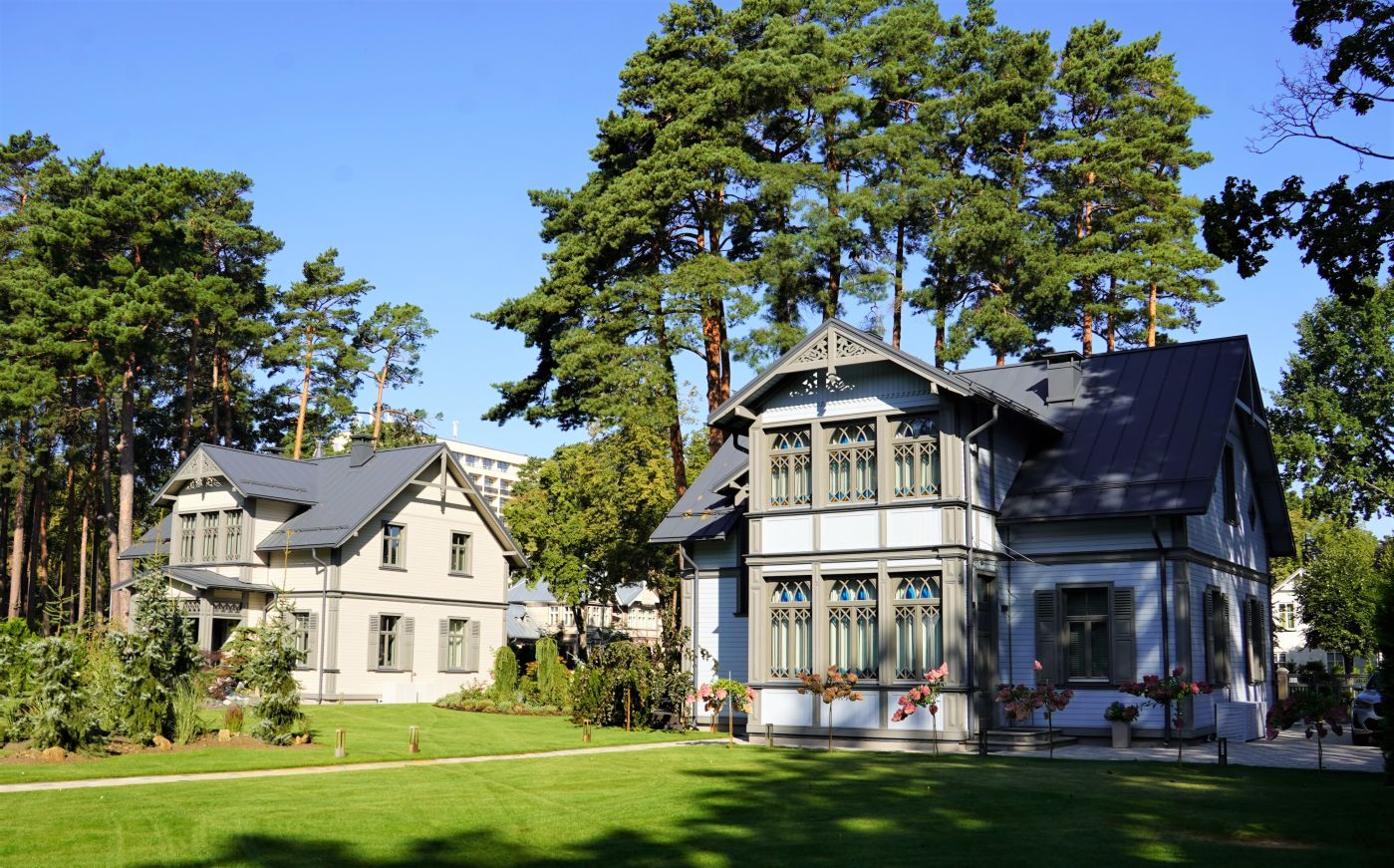

Meža prospekts 8 (k-1, k-2, k-4), Bulduri (Jūrmala Historical Architecture Award 2024 – finalist, culturally significant buildings and historic background development)
These wooden summer houses, built in the early 20th century and set among pine trees, form a unified and expressive architectural ensemble. Their façades are decorated with delicate wood carvings, decorative panels, and the plane-shaving-flower motifs characteristic of Jūrmala, while corner turrets with pointed roofs lend the composition a pronounced vertical accent. Long abandoned, the buildings have now been rebuilt while preserving their historic volumes, proportions, and richness of architectural detail. The ensemble is complemented by a contemporary extension with broad glazed surfaces that reflect the historic façades and subtly continue the dialogue between old and new. The solutions used in the reconstruction – windows based on the traditional box-window principle, stained-glass elements modelled on historic examples, and decorative timber detailing – help preserve the character of Jūrmala’s summer-house architecture in its renewed form.


Dzintaru prospekts 3, k-2, Dzintari (Jūrmala Historical Architecture Award 2025 – finalist, culturally significant building to be preserved)
This house is one of three almost identical buildings next to Dzintari Concert Hall – a small urban ensemble sometimes referred to as Jūrmala’s “Three Brothers.” The three similar buildings on a single plot create a distinctive quarter composition and form an important part of Dzintari’s historic built fabric. The house was built in 1930 to a standard family-house design of the time, with National Romantic details. Even today, this ensemble preserves its original spatial arrangement within the pine-fringed setting and makes it possible to imagine the architecture of the Dzintari resort in the early 20th century.


Aglonas iela 1, Dzintari (Jūrmala Historical Architecture Award 2024 – finalist, local cultural monument)
Built in 1910, this guesthouse is an expressive example of Art Nouveau wooden architecture in Jūrmala. Its asymmetrical composition, with a corner tower, verandas, and a mezzanine – a small superstructure above the main storey – gives the building a picturesque silhouette that sits especially harmoniously within the pine-fringed coastal landscape. The façade is enriched with abundant carved decoration, including delicate window pediments – ornamental timber features above the windows – and ornamental bands that reveal the period's craftsmanship. During restoration, the historic timber details were carefully renewed, preserving the building’s authentic charm, which still epitomises the classic Jūrmala summer house.


Tirgoņu iela 6, Majori (Jūrmala Historical Architecture Award 2024 – 3rd place and Public Choice Award, culturally significant building)
Stopping in front of this building, one sees what appears to be a classic Jūrmala wooden summer house with a balcony richly adorned with wood carvings. In reality, it is a fully reconstructed building – behind the façade characteristic of historic architecture lies a modern, energy-efficient dwelling with a well-considered layout and a quiet inner courtyard. Built around 1920 as the gardener’s house for the neighbouring villa, the building’s façade still bears the influence of Art Nouveau, especially in the balcony composition and the carved patterns. Interestingly, the façade ornaments were reconstructed through a combination of hand craftsmanship and modern technology – so precisely that even a trained eye may struggle to tell which details were made a hundred years ago and which have been created today.

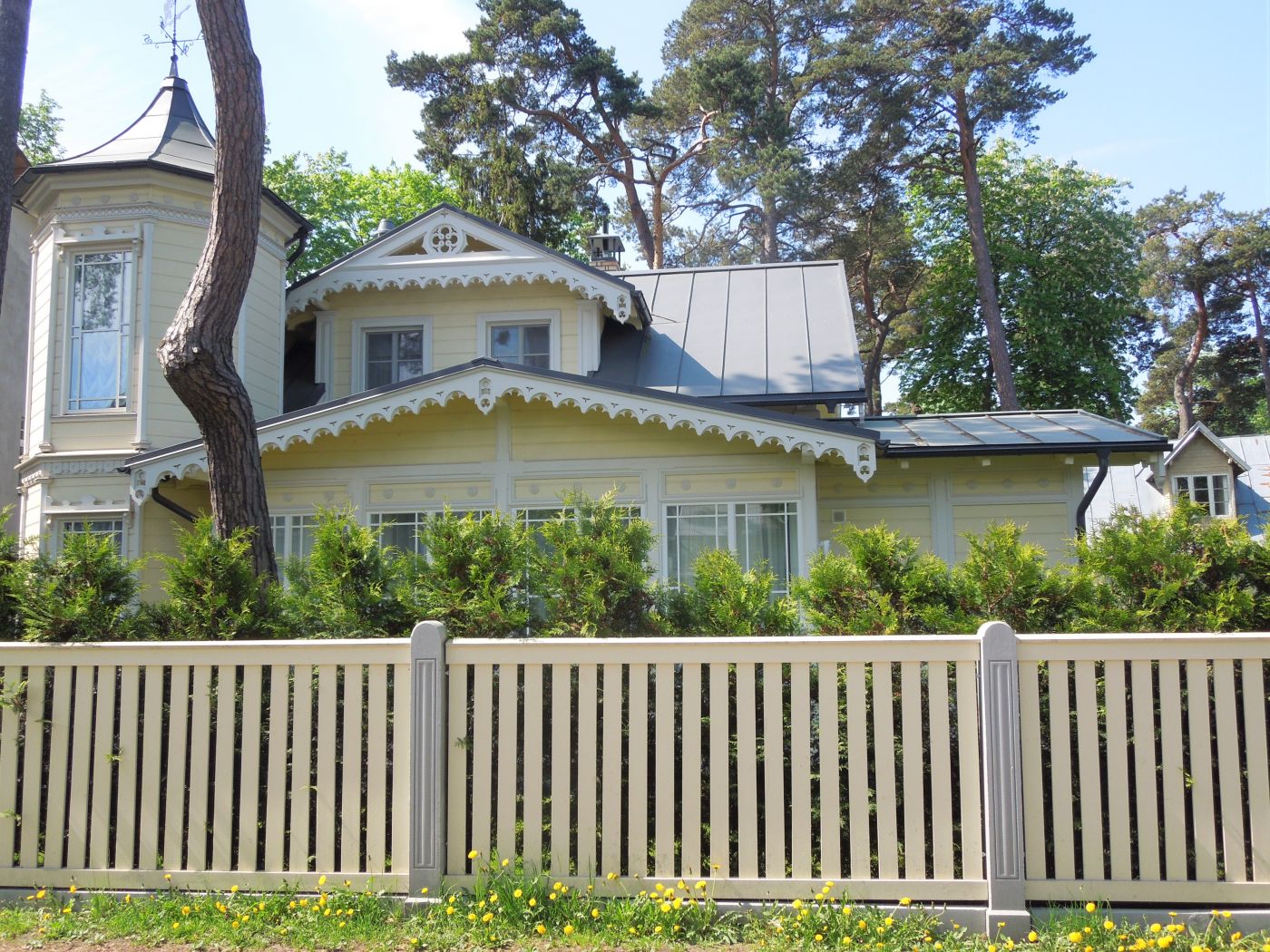


Jaunā iela 3, Majori (Jūrmala Historical Architecture Award 2024 – 2nd place, local architectural monument)
Built in the early 20th century, this wooden summer house originally served as a seasonal residence, and its architecture reflects both Art Nouveau and Neo-Gothic influences. Its silhouette is defined by a veranda and a multifaceted corner turret, while a long service extension was later added – the once characteristic Jūrmala summer kitchen, where cooking was done during the warmer months so that food smells would not drift into the living quarters. During reconstruction, the building's historic character was carefully preserved, and most of the carved ornaments on the façade are exact replicas of the originals. The interior also revealed a surprising discovery: beneath the plaster lay several layers of old wallpaper, including dark blue wallpaper backed with fragments of St Petersburg newspapers from 1902, offering a glimpse into this summer house’s life story spanning more than a century.


Alfrēda Amtmaņa-Briedīša iela 2, Vaivari (Jūrmala Historical Architecture Award 2025 – 2nd place, local architectural monument)
This picturesque wooden summer house with a corner turret was built around 1870 as a summer residence with single-sash windows. When the current owner first viewed the building, its 1930s interior still survived – Art Deco chandeliers, furniture, chests, and even a piano. The turret door had been sealed beneath several layers of wallpaper, and when it was opened, it felt as if no one had entered the room for at least half a century. During restoration, a board bearing a pencil inscription was found in the veranda ceiling: “These ceilings were made by two fine craftsmen on 21 May 1929,” while the house still retains its original stove, parquet flooring, and foundations more than ninety years old.


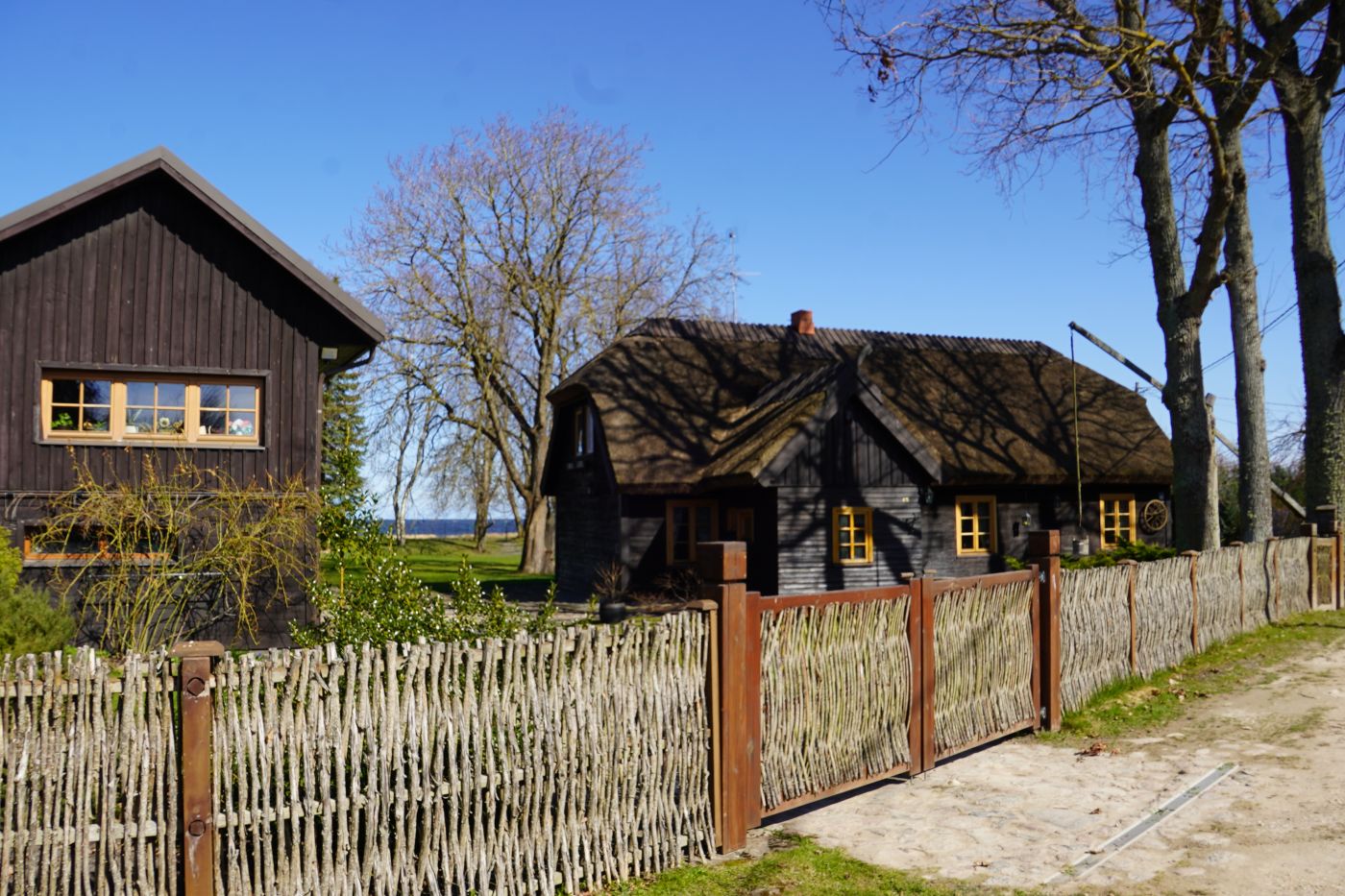
Kaugurciema iela 65, Kaugurciems (Jūrmala Historical Architecture Award 2025 – 1st place and Public Choice Award, culturally significant building to be preserved)
This log house with a reed roof, standing within a fisherman’s homestead right by the sea, has been here since 1868, when the Daugava ferryman and fisherman Štrauss built it. The house has survived wars and storms, and its story is continued today by the Kronbergs family, who have lived here since the late 20th century. A reed roof on houses of this kind lasts around half a century, and here too it is renewed from time to time – as the owner says, “bundles eight to ten centimetres thick are stacked and fastened together, and they hold firm.” Around the house, the historic fisherman’s yard has survived, with its traditional paling fence, well, and old cellar with a small chimney.
***
The Jūrmala Historical Architecture Award highlights the careful work of owners, architects, and craftsmen whose efforts help preserve the city’s unique built heritage and give it new life today. If your property includes a culturally significant building that has recently been restored, rebuilt, or renewed and was commissioned last year, it may also be nominated for the Jūrmala Historical Architecture Award.
This material has been prepared in cooperation with the Jūrmala Centre for Cultural Space and Environmental Design.